Showing posts with label Islamic History. Show all posts

Saturday, January 18, 2020

Masjid Sheikh Zayed | UAE's Sheikh Zayed Grand Mosque in Abu Dhabi

Bismillah.

I just wanted to record this special memory here for eternity - an unforgettable experience that took place on 9 April 2019. It is a significant date for me personally because this blog was launched on the 9th of April 2009. I was absolutely thrilled that I got to share the wonderful experiences with my beloved mother. It was yet another generous gesture from the Lord.

Below are some photos for our viewing pleasure. Indeed Allah is Beautiful and He loves beauty. Masjid Sheikh Zayed, in my opinion, is the most luxurious mosque on earth. Did you know that all the Muslim construction workers, professionals or otherwise had all observed the daily prayers in congregation, on-site, throughout the construction period? And... the Project Manager was a lady! MaShaAllah. 


Mother & Daughter


My most favorite shot!  

May Allah increase His bounties, indeed we are certainly grateful for His generosities. We are amazed at how He keeps delighting His servants no matter how indolent we are. 
Subhanallah wal hamdulillah wa la ilaha illallah wallahu akbar!


- E. Ismail
18 Jan 2020


Friday, January 19, 2018

Jummah Mubarak | Sollu Alan Nabi

Bismillah.

Assalamualaikum warahmatullah.

We know we have quite a strong attraction to the Prophet salallah alaihi wasalam, hence we quickly pulled over by the roadside upon seeing a group of children reciting salawat loudly as they marched towards a mosque in Melaka, Malaysia.

This kind of simple but meaningful joy of life is what we live for.

May Allah make our tongues light to recite quietly as many salawat as possible whenever we are alone or in public.
Ameen.


This was at Masjid Tengkera in Melaka, which was built by Muhammad Salleh, a mualeem cum trader from India in 1728. This took place when Melaka was colonized by the Dutch.

Al Fatihah to the honorable Muhammad Salleh who evidently left a wonderful legacy that could still benefit us to this day.

The maqam of Sultan Hussin Muazzam Shah who witnessed the signing ceremony that marked the establishment of Singapore in 1819 by Raffles, is located within the mosque compound.

May we learn from the past and be mindful of the kind of history/contributions we leave behind.


Masjid Tengkera and Masjid Kampung Hulu
are two must-visit mosques if you happen to be in Melaka.

Wednesday, March 22, 2017

P. Ramlee (1929-1973) - Malaysia's Most Popular, Much-Loved, Multi-Talented and Spiritual Artist Of All Time

Bismillah.

He would be 88 years old today, 22nd of March 2017.

P. Ramlee is without a doubt, Malaysia's most popular, much-loved, multi-talented and spiritual artist of all time. He was born on 22nd March 1929 in Penang [where all the charming and wonderful people were born, like yours truly. LOL].

He died in 1973 at the age of 44, a mere 25 years after he began his career as an actor. He was 19 years old when he first started acting. He might have started out as an actor, but he died as a popular singer, songwriter, director, and film producer. 

That which he labored for 25 years (from age 19 until his passing at the age of 44) resulted in a handful of evergreen and much-cherished films, jokes and songs. It was as if he knew he would be irreplaceable, he wrote or rather gifted us Malaysians and Singaporeans with a beautiful love song - Di Mana Kan Ku Cari Ganti. [lit: Where would I find a person who could take your place.]  

I didn't regard P. Ramlee as a spiritual person until I heard it from a popular Malaysian dai'e Ustaz Don during a talk at my office. If I recalled correctly, Ustaz Don realized this to be true when he heard it from Dato Dr. Afifi Al-Akiti - a highly regarded Malaysian scholar.

I also heard from Yusnor Ef who used to be close to the late P. Ramlee, how spiritual the latter was. I had the privilege of meeting Yusnor and listened to him relate lovingly the experiences he had with P. Ramlee, how he met the big star for the first time and how P. Ramlee agreed to teach him script-writing. When Yusnor narrated the way P. Ramlee spoke and carried himself, it was as if we were watching him in one of his films. It was mesmerizing and funny.

Yusnor Ef began learning script-writing from P. Ramlee in 1962 when he was a teacher at a school in Tekong Island off Singapore. He would visit P. Ramlee's house at Cedar Avenue in Singapore after school. Yusnor Ef remembered P. Ramlee telling him how he would sometimes get stuck in his creative work, he would refer to God and would almost immediately recover his creative flow.   

Allahu a'lam.

   
Today, 22nd March 2017, Google honors P. Ramlee with a doodle


Yusnor Ef showed me a book he authored during my meeting with him about a month ago.
He also wrote a book about his experiences with P. Ramlee "P. Ramlee Yang Saya Kenal"
[P. Ramlee Whom I Knew]
"Music is food for the soul and it is a Universal Language. When a person is keen on arts and beauty, he/she should try to feel the presence of Allah in that beauty." -  Hamka (a renowned Sufi of Indonesia)
"Arts is one of Allah's work. Therefore, give your best with much honesty." - P. Ramlee
[As quoted in Yusnor Ef's book]


P. Ramlee's (arguably) most popular song
Di Mana Kan Ku Cari Ganti
[Where would I find one who could replace you]

Excerpts of the lyrics:

Where would I find a person who could take your place
one who is similar to you
I dread this separation and broken feeling
restlessness...

Where would I find one who could replace you
Might it be in the Heavens
A friend who would share my pain
and cry together
forever


Tuesday, November 18, 2014

Dato' Jenaton | The great Gelugorians

Bismillah.

I am proud to say I'm from Gelugor, Penang. Proud of my roots yes, I'm a Gelugorian!

On my recent trip back here, I noticed the road signage from the Penang Bridge leading to my kampung (village) all had been changed from Gelugor to Glugor. Not sure why and I'm not sure now which is the correct spelling. The kampung got its name from a tree Asam Gelugor whose scientific name is Garcinia Atroviridis.

Garcinia would have been a cool name for my village, don't you think so? Anyhow, as a Gelugorian, it would be a shame if I did not mention something about Dato' Jenaton because it was he who established the earliest settlements here. According to reports, he was a prince from Minangkabau, Indonesia. He was also a chieftain at Batu Bara (North of Sumatera) who travelled [sailed] frequently between Batu Bara, Kedah and Penang. In those days, Penang was under the reign of the Kedah sultanate. For the benefit of our foreign readers, Kedah is a state on mainland of northern Peninsula Malaysia. The Sultan of Kedah, Sultan Muhammad Jiwa Zainal Abidin Shah II, gifted him with 100 acres of land where Batu Uban and Gelugor is now situated. [We mentioned Batu Uban in the last few postings, it's to the south of Gelugor on the east coast of Penang island.] 

The then Sultan of Kedah favored Dato' Jenaton and presented him with the property because he helped the former strategize and win the Kedah's war against the Acehnese and the Bugis. This took place in 1749, about 15 years after Haji Muhammad Saleh @ Nahkoda Nan Intan arrived in Batu Uban, built a mosque there and hence established the first Muslim/Malay settlements in Penang in 1734.

Dato' Jenaton ibni Raja Labu [also spelled Jannatun] arrived in the Batu Uban/Gelugor area with 90-odd followers from Batu Bara. In short, he was a successful trader who was also good in devising war strategy and that had won him large tracts of land which he invested in coconut and sugarcane plantations in Gelugor. 

From this very smart and enterprising personality, we have got great Gelugorians like two brothers Aziz Ishak and Yusof Ishak who founded the country's premier publication the Utusan Melayu in 1939. Yusof Ishak was also the first president of Singapore!

Their other brother Rahim Ishak served as Singapore's state minister under Singapore's President Lee Kuan Yew. The other two notable descendants of Dato' Jenaton are former Supreme Court judge, Tan Sri Wan Sulaiman Pawanteh and the renowned diplomat Tan Sri Razali Ismail who was once Chairman of the UN Security Council and president of the United Nation General Assembly, in the late '90s.

We got to know about this fascinating story of Penang's first founders and settlers, thanks to Prof. Dr. Ahmad Murad Merican, a historian who is also a descendant of Dato' Jenaton.

There is a Malay saying Benih yang baik jatuh ke laut menjadi pulau which roughly means: a person who comes from a good background, will most certainly become a distinguished person no matter where they go. [bi iznillah]

This is a fitting description for Haji Muhammad Saleh @ Nahkoda Nan Intan, the multi-skilled Sufi who was first to arrive in Penang and built the first mosque in Batu Uban in 1734 and also Dato' Jenaton who expanded and made flourish the early settlements in Batu Uban and the Gelugor area, in 1749.

As a Gelugorian, I am indeed proud and thankful for these cool people of the past who left us with such a great legacy in Penang and beyond.

Alhamdulillah wa shukrulillah.

Entrance to Dato' Jenaton's maqam
in Minden Heights, Gelugor, Penang

Grave of Dato' Jenaton
Photo credit:
 http://theearlymalaydoctors.blogspot.com/2012/05/makam-datuk-jenaton-makam-datuk-setia.html 


Reference:


Sunday, November 16, 2014

Haji Muhammad Saleh a.k.a. Nahkoda Nan Intan | Batu Uban Mosque in Penang

Bismillah.

Alhamdulillah, we were able to visit Masjid Batu Uban where its founder and first imam Haji Muhammad Saleh or Nahkoda Nan Intan were buried. We were not too sure which was the exact maqam but inclined to believe it's one of the two located inside a demolished wall at the foot of a Banyan tree.

Two graves within a demolished wall
on the south side of Batu Uban mosque.
The one on the left side is marked as per below photo.
The one on the right is unmarked.

Al-Fatihah
Shaykh Muhammad Saleh ibni Shaykh Ahmad Al-Makkawi
Jumaat, 5 Jamadil Awal 1332H
[The name seems right but not the date. Allahua'lam]

Masjid Batu Uban was opened in 1734 by Haji Muhammad Saleh,
a religious leader and Sufi master who became its first imam until his demise

Batu Uban is Malay for 'grey hair rock' after a sea boulder which had grass over it that looked like grey hair. Batu Uban mosque was originally situated next to a beach and right on the beach was an ancient well which is now motor-operated. Despite being very close to the sea and the fact that the well had to be covered during high tide, the water has always remained fresh. 

Ancient well upgraded.
Imagine this being on a beach, once upon a time. 

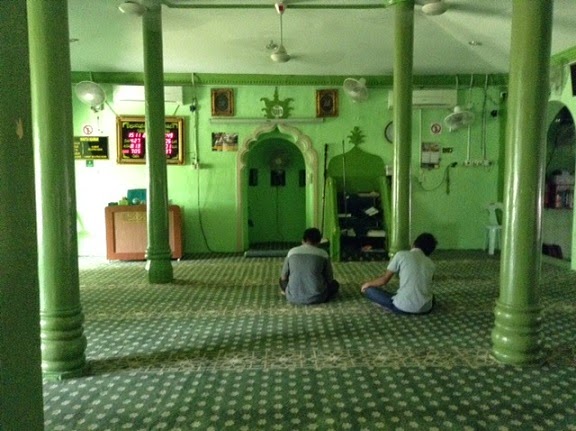
Main prayer hall at Masjid Batu Uban.
Haji Muhammad Saleh actually brought the 4 pillars (cengal wood)
from Sumatera/Indonesia on boats.
As mentioned in the previous posting, Haji Muhammad Saleh or Nahkoda Nan Intan was a royalty from Payakumbuh in Sumatera/Indonesia who traveled to Penang and built this mosque in 1734. He also established the first Muslim settlements on the island. Imagine him being busy as imam of the mosque, busy planting coconut, banana and sugarcane, busy ferrying mosque materials from Sumatera. Before coming to Penang, he was reported to have built a mosque in Tengkera, Melaka in 1728.

Haji Muhammad Saleh was a multi-skilled person. He was a religious leader and a Sufi who was skillful in seafaring, agriculture, and carpentry. He was clearly one of the cool people of the past from whom we should draw inspirations and encouragement in doing as many lasting good deeds as possible. Bi iznillah.

***

Tuesday, November 11, 2014

Masjid Tengkera | Shaykh Abdul Latif - scholar, writer, philanthropist


Bismillah.

A couple of postings ago, I briefly wrote about a trip to Pulau Besar, Melaka (two hours south of KL). After visiting the grand maqam of Sultan Ariffin Shaykh Ismail on the island, we left with one intention, that's to stop by at Masjid Tengkera on mainland. I thought my travel mates ought to see the mosque because it's chic, classic and pretty.  

It was my second time there and their first time, yet it was the 'first timers' who indirectly introduced me to one excellent personality - the late Shaykh Abdul Latif bin Haji Muhammad Nuruddin @ Haji Tamby (1872 - 1939) who was buried within the compound of the lovely mosque. The description of him on the notice board was very impressive. To me, he is a superb-man.

Shaykh Abdul Latif who was of Indian descent, was a renowned scholar, not just in his home state Melaka but also Penang, Singapore and Indonesia. Imagine being sent off to study in Mekah at the tender age of 8. The shaykh then spent some 20 years studying under prominent Malay scholars in Mekah, among whom was Shaykh Muhammad bin Ismail Daud al-Fathani.

Upon his return from Mekah, he became a well known scholar himself especially in Singapore where he first began teaching from a nook on Arab Street where his father owned a textile shop. He was also a prolific writer/publisher who had his own printing company - the Lathifiyah Press in Singapore and another one in Melaka. His enterprising capacity enabled him to be generous towards others. Shaykh Abdul Latif was also well liked for his oral skills and humor. 

It was his great grandfather Haji Muhammad Saleh who built the Tengkera Mosque in 1728. Six years later, in 1734, Haji Muhammad Saleh who was also known as Nahkoda Nan Intan became the first man to have discovered Penang ahead of Captain Francis Light and opened Penang's first mosque in Batu Uban. In 1896, as a good friend of Habib Noh the grand saint of Singapore, he built a mosque adjacent to Habib Noh's maqam. 

How cool is that? Learning history is indeed fun. Visiting maqam of such great people makes us realize how insignificant we are.

The maqam of Shaykh Abdul Latif and his father Haji Muhammad Nuruddin @ Haji Tamby are located at Masjid Tengkera in Melaka. The maqam of his great grandfather Haji Muhammad Saleh @ Nahkoda Nan Intan is situated at Masjid Batu Uban in Penang.

Reference:
http://ulama.blogspot.com/2005/03/syeikh-abdul-lathif-tambi.html
http://262bandahilir.blogspot.com/search/label/Masjid%20Tengkera%201728

Thursday, August 22, 2013

Wan Yahya bin Wan Mohd Taib (1870 - 1935) - His hajj story

Bismillah.

I am yet to properly read the "One Thousand Roads to Mecca" - edited and introduced by Michael Wolfe. I would love to read Shafiq Morton's "Notebook from Makkah and Madinah". I am yet to watch the documentary of Martin Ling's pilgrimage. I dream of writing about my own hajj experience someday InshaAllah but no way would it be as interesting as this hajj stories of Haji Wan Yahya bin Wan Mohd Taib (1870 - 1935).

I learned about his fascinating hajj experience from a write-up given out during the recent "Penang and the Hajj" conference. It's written by Mohd Isa Othman of USM and Mohd Kasri Saidon of UUM. For the benefit of our foreign readers/visitors, USM and UUM are two top universities in the northern part of Peninsula Malaysia.

Haji Wan Yahya was working with the Kedah state government when he performed the hajj in 1914. Kedah is a state in the northwest of Peninsular Malaysia, neighboring Penang to its southwest. Haji Wan Yahya was not just an ordinary staff, he was considered among the state's elite officers because of his credentials having served as a Police Inspector, a District Officer, Chief Magistrate, and the Judge of Kedah's Court of Appeal, among others. He is remembered for being the first to initiate the construction of a 7km waterways for padi irrigation, known to this day as "Sungai Korok Wan Yahya", and a road connecting Jitra and Kodiang in Kedah circa 1902. His father was remembered as a Kedah hero who fought and died defending the state against Siam [now Thailand] in 1838.

Haji Wan Yahya wrote about his hajj stories in the Malay language but opted for an Arabic title - Tarikh al-Siyahah Ila Makatul Mukaramah (Notes on Travels to Makkah). As a government officer, Haji Wan Yahya had to apply for hajj leave. The Crown Prince who was heading the State Council granted him a leave of 8 months and also advanced his salaries for six months, on top of a loan of 500 riyal. Haji Wan Yahya also enjoyed other state's privileges. He boarded Darulaman (a Kedah state's sea vessel) from Alor Setar to Penang where he was to officially depart for hajj. In Penang, he, his wife and their adopted child stayed for 12 days at the Kedah State's House in Kelawei, while waiting for Nova - the ship that would take them to Port Said in Egypt before continuing on their journey to Cairo via train and back to Port Said on a Russian vessel and afterward, a train ride to Syria, Jerusalem and lastly Madinah. A stark contrast to their first-class cabin on Nova, the last leg of their journey from Madinah to Makkah was on a camel for 11 nights. An experience which was way too uncomfortable compared to the elephant-rides he was accustomed to in Kedah.

Nova according to Haji Wan Taib’s narration was a 6000 ton vessel belonging to the Peninsular & Oriental Steam Navigation Company. His first class return ticket, purchased through the P & O Company cost him around $340 [not sure if it was riyal or pound]. The ship left Penang Port at 7 a.m. on 19 November 1914. After three days, they stopped by Colombo before making another stopover in Aden. Unlike the many stories about hajj voyage heard from my mother, Haji Wan's experience was unique in that it sounded more like a cruise ship where passengers were expected to wear evening dress for dinner. Adults and children would eat separately. Passengers would be fined 500 pounds if they had brought matches with them. By comparison, most other pilgrims on board other ships had to bring their own stove, gasoline, pots and pans as they had to cook their own meals.

One lady who attended the Penang and the Hajj conference, related her experience being a 9 year old pilgrim. She, her siblings and parents, all ten of them chartered an entire train coach from Perak to Penang before traveling on one of the popular hajj ships - Serombong Biru (the Blue Funnel). They brought 10 gunny sacks of rice, and food supplies such as anchovies, pickled chilly, soy sauce and dried fish. Their hajj arrangements were handled by a Shaykh Haji named Shaykh Arshad who lived in Kelawei, Penang. Upon arrival in Mekah another Shaykh Haji by the name of Shaykh Abdul Manan took care of them. As a 9 year old girl, she remembered seeing thousands of people at the Penang Port. She remembered vividly when the Blue Funnel made a stop in Aden, the locals would swim around their ship begging for money and passengers would throw coins into the sea for the beggars to catch. And of course she remembered suffering from sea sick. I think that is why my great grandmother would prepare loads of tamarinds as snacks for the would-be hujjaj in our village.
    
To be continued Insha Allah.      

Monday, December 24, 2012

Kampung Hulu Mosque: A kind gesture of the Dutch


Bismillah.

We should thank the Dutch really. Unlike the earliest conqueror of Melaka, the Portuguese, the Dutch had actually encouraged religious pluralism and ordered the kapitan of the time to commission a mosque to replace Melaka's first mosque which the Portuguese had destroyed circa 1511.

Kapitans were considered as community leaders as they were usually socially active, influential and financially capable. The Kapitan Keling mosque in George Town Penang was also built (in 1801) by a kapitan, an Indian Muslim named Caudeer Mohudeen.

The construction of Masjid Kampung Hulu near the famed Jonker Street in Melaka was led by a kapitan by the name of Dato' Shamsuddin bin Arom in 1728 and it was later refurbished by Wazir al-Shaykh Omar bin Hussain al-Attas.

Masjid Kampung Hulu is Malaysia's oldest mosque.

Unlike many other mosques in Malaysia which mostly employed Arabic architectural styles, Masjid Kampung Hulu cherished the traces of Javanese and Chinese influences on the local communities. The only exception was that, brick and stone walls had been constructed instead of the typical wooden walls found in Javanese mosques.

Adorning the holy ground of this heavily visited masjid is a maqam of a wali - Sayyid Abdullah al-Haddad.

It is well known among the locals that this masjid is one of the few sacred places where one's petition will be granted. 

Allahu a'lam.


Masjid Kampung Hulu - built in 1728
Malaysia's oldest mosque
http://www.orientalarchitecture.com/malaysia/melaka/hulu

A sneak view inside the male/main prayer hall.
Ablution area.
Water is said to have miraculous properties.
Allahu a'lam

References:
http://archnet.org/library/sites/one-site.jsp?site_id=7484
http://www.mbmb.gov.my/masjid
http://www.waymarking.com/waymarks/WMA220_Masjid_Kampung_Hulu_Melaka_Malaysia
http://www.tourismpenang.net.my/index.php/Heritage-Buildings/kapitan-keling-mosque.html

Tuesday, July 10, 2012

Tun Perabu - the mighty lady saint of Temong | Tok Temong


Bismillah.

Tun Perabu was her real name. She became known as Tok Temong after her death. She lived in the early 16th century in Temong, a small district in Perak (a state in Malaysia) where she once ruled. Her maqam which we had visited for the first time last Saturday, is situated on a riverbank, not far from Kuala Kangsar. 

Her elder brother, Tun Saban, arrived in Perak prior to the installation of an official sultanate. Together with one man by the name of Nahkoda Kassim, Tun Saban had an audience with Sultan Mahmud Shah of Kampar (Sumatera/Indonesia) asking the Sultan to nominate a ruler for Perak.

Prince Mudzaffar, Sultan Mahmud's son then became the first Sultan for Perak in 1528. It was reported that Tun Perabu presented the new sultan with a special talisman known as 'Mustika Embun' (a petrified dew). It then became a significant article used during an installation ceremony of a new sultan in Perak to this day. Sultan Mudzaffar Shah offered Tun Perabu a gift in return, but she declined. Instead, she asked that she be allowed to rule Temong on the left side of the Perak river bank, while the Sultan kept to his area on the right side of the river bank.

Each new sultan of Perak would customarily conduct visitation to her maqam. But it is worth noting that the maqam does not contain her body as it had "disappeared" during her funeral. The people then buried only her cane at the site which is also known as 'Kramat Tok Temong'.

According to one senior Naqshbandi mureed, Almarhum Shaykh Raja Ashman is said to have had a special spiritual connection with Tun Perabu. His followers are encouraged to pay a visit to her maqam. Last Saturday, prior to attending the majlis tahlil for Almarhum Shaykh Raja, Shaykh Adnan Kabbani led the jemaah to a special prayer at Tok Temong's maqam.

Wallahu a'lam.

p/s May Allah strengthen our hearts on matters of the unseen involving His saints. May Allah make us benefit from any special gifts which He might have bestowed upon Tun Perabu. Al Fatihah.

Reference: http://sultan.perak.gov.my/bahasa/toktemong.htm


Sunday, April 3, 2011

Intercession of the grand saint of Singapore

Bismillah.


A supplication by Tok Mat the Carriage Driver
as quoted in the above book which may be purchased
at the maqam of Habib Noh.
***
"Tok Mat worked as a horse carriage driver,
ferrying passengers to and fro.
His was a dangerous occupation:
19th-century was rife with robberies and murders,
especially at night.
Tok Mat knew Habib Nuh and regularly transported him around,
free of charge, only hoping for the blessing of his saintly grace.
One night, Tok Mat had to ride alone across an area,
which he knew to be very unsafe.
He was gripped with fear.
He made a silent prayer to Allah that his journey be eased
by somehow meeting him with Habib Nuh along the way
so that Habib Nuh could intercede for his safety.
As soon as this prayer crossed his heart,
he looked up and saw Habib Nuh in the passenger cabin,
smiling at him.
He knew that he had nothing to fear,
and rode home safely."


The maqam is open daily. Visiting hours: 9 am - 9 pm
Closed for 10 minutes before and after prayer times.

We all hope to stand in the saintly rays of barakah
bi-iznillah

Monday, November 1, 2010

Miracles of Tok Kenali - a Malay saint of the 19th century

Bismillah.


Tok Kenali or Muhammad Yusof bin Ahmad (1870 - 1933 CE) was born in Kelantan, a state in the northeast of Peninsular Malaysia. Orphaned at the tender age of 5, Tok Kenali grew up under the care of his pious grandfather Tok Salleh, from whom he studied the Qur'an. He learned the Arabic language and the basics of Islamic teachings at Masjid Al-Muhammadi and several religious institutions in Kelantan from 1879 to 1887 before furthering his studies and performing hajj in Makkah.

Tok Kenali was 18 years old when he sailed to Makkah. In an interview with his youngest son and grandchildren aired on a Malaysian tv station last Friday, Tok Kenali was said to have embarked on the journey with only RM22.00 in his pocket. With that amount of money, he had spent 22 years studying at Masjidil Haram. He came back to Malaysia in 1909 and established his own madrasah before assuming the post of headmaster at Masjid al-Muhammadi in 1912. He died on 19 November 1933 at the age of 65.

Stories of his karamah first became known when he was sailing to Makkah. The voyage got delayed in the Indian Ocean for a long time because the ship's mast had broken. Tok Kenali helped restore the ship and made it reach Makkah after being at sea for six months. While in Makkah, Tok Kenali appeared as a student with a strange personality. He lived a simple meager life while focusing his efforts on acquiring knowledge. He did not have any spare clothes and seldom ate any meals. He was seen attending one halaqah (classes) after another without bringing any kitab. Other sources said that he would buy one kitab in a year and sell it afterward or sometimes borrow kitab from his guru. He was often caught sleeping during lectures.

One day, during a halaqah of Shaykh Ahmad Al-Fathani, Tok Kenali who had fallen asleep was called by the guru. Al-Fathani woke him up to ask three difficult questions which none of the other students could answer. His guru had purposely prepared the questions to test Tok Kenali if he was truly gifted with 'ilm laduni. He surprised many as he was able to answer the questions well. Needless to say, he impressed his guru and from that incident onwards Tok Kenali became close with Shaykh Ahmad Al-Fathani and began to serve him for many years.

Tok Kenali's mureed especially those who dedicated their time as his khadam (those who served him) were renowned gurus too. According to a member of his family, Tok Kenali's karamah became the talk of the town when someone who had gone for pilgrimage saw him put out a fire in Mina. It was narrated that Tok Kenali was in the midst of teaching in Malaysia when that event occurred. He excused himself from class and miraculously 'left' for Mina. Upon his return, his students noticed that Tok Kenali had ashes on his turban.

One Malay historian by the name of Wan Shaghir Abdullah traced Tok Kenali's roots to a  clan from Caiyya (Cahaya) in south Thailand. He would be given a royal treatment every time he visited Caiyya. The locals idolized him and often asked for his prayersThe Caiyya people believed that any du'a he made would be granted maqbul.

Tok Kenali was not only known for his karamah, he was also remembered as editor and writer for several publications. He founded a Malay magazine called Pengasuh which continued to be published until today (2006). His writing flair was evident even as a student. A lithograph on the virtues of Imam Bushiri's Burdah (Risalatud Durril Mantsur) which he composed was published in Makkah circa 1892. His books on sharaf and nahu (Arabic grammar) were published while he was back teaching in Kelantan. 

Tok Kenali was married to Cik Ruqayyah Mahmud. Their four children, Ahmad, Muhd Shaalih, Mahmud and Abdullah Zawawi too became respectable Islamic scholars in their own right.

Reference:
1. Article by Wan Mohd Shaghir Abdullah
2. TV1 program 'Lambaian Kaabah: Kelana Anak Melayu' 28 October 2010 
3. Biodata Tok Kenali originally published on www.tok-kenali.net

Thursday, November 26, 2009

Sheikh Omar Basheer al-Khalidi

Sheikh Omar Basheer al-Khalidi
19th century Naqshbandi Sufi leader of Penang


Bismillah.

Sheikh Omar Basheer al-Khalidi (d. 1881) had achieved something few religious leaders could achieve. A migrant from the blessed region of Hadhramaut, Yemen, Sheikh Omar had brought to Penang not only his personal religious discipline but leadership charisma that appealed to the British government who was ruling Penang then. He was very well known as a Naqshbandi Sufi Shaykh who introduced the special tariqah practice called suluk. He was also very well known among the ruling elites who were indebted to him for his ability to mediate during the Penang riots of 1867.

The house depicted in the painting below was used for suluk where Naqshbandi tariqah followers would live in for an extended period of time and dedicate their time doing zikr under the guidance of Sheikh Omar. According to his grandson, Haji Fathil bin Sheikh Zakaria Basheer, members of Kedah royal family were among those who used to frequent the 'Suluk House'. Sheikh Omar was from the Khalidiah branch of Naqshbandi which until today emphasizes on seclusion. He thus carried the title al-Khalidi.

I thought Sheikh Omar was special because he did not seem to be apologetic nor was he secretive about his involvement in tariqah. In fact, he did not allow his personal religious inclinations to hinder him from taking part in public affairs.

The description accompanying Sheikh Omar's portrait above noted that the secretary to Captain Francis Light (British founder of Penang) had in 1860 built a house for Sheikh Omar where he lived until his death in 1881. It was also recorded in the annals that Sheikh Omar had lived at No. 69 Lebuh Acheh, at the heart of a Muslim center for hajj, trade and Islamic studies. Upon Sheikh Omar's demise, his son, Sheikh Zakaria took over the role of Penang's most notable religious leader. Sheikh Zakaria was appointed as Penang's first mufti and later, another son of Sheikh Omar (Sheikh Yahya) followed suit and became Penang's first qadi. They both operated from the same address. Eventually, in 1917, No. 69 Lebuh Acheh evolved into a madrasah for Qur'anic studies.

Sheikh Omar's tomb is located in Kampung Melayu, Ayer Hitam, Penang, underneath a 35-foot white tower (picture). Built by Muslim labourers from India, it is regarded as the largest and most handsome Muslim mausoleum in Penang. It is regularly visited by Naqshbandi followers as well as non-tariqah public from near and far places such as Pakistan and Lebanon.
__________________________________________
I felt honoured for the opportunity to visit Sheikh Omar's tomb again today. Alhamdulillah wa shukrulillah. Know that we belong with those who adore and cherish awliya Allah and we pray to Allah s.w.t so that we too would be istiqamah in our zikr; so that we follow in their footsteps in becoming close to our Creator and useful to the ummah. Ameen Allahumma Ameen.

References:
Housing, Building and Planning USM
Signboard at Mausoleum
Picture was taken at Haji Fathil's Resident
Harian Metro dated 27 March 2009

p/s Did I tell you that I grew up in Kampung Melayu, Ayer Hitam, Penang - a humble neighbourhood blessed by such a holy presence. I recalled the nights when I stayed up to study, I would take a break on the balcony of my family's flat on the 9th floor. Every time, I mean every time I stood there, my eyes somehow always landed on the dome of the mausoleum. In the stillness of the night, the dome looked mysteriously majestic yet intensely serene. I know in my heart that I would not be the person I am today without the barakah from Sheikh Omar Basheer al-Khalidi. Al-Fatihah.


Thursday, July 30, 2009

Habib Neon - The Habib who glowed in the dark!

Bismillah.

MashaAllah Tabarakallah! I have never heard of anyone whose body glows in the dark - literally glows, emits light, until a lady of Habib Ali bin Jaafar al-Idrus family pointed at a photo in their living room and said to me, "That Habib is known as 'Habib Neon'!" It was a picture of Habib Muhammad bin Husin al-Idrus (1898 -1969). A very good looking man! Unfortunately, I was not allowed to take any photos but fortunately, I found some on the internet. So here he is.


Once upon a time, at a masjid in Surabaya, Indonesia, people gathered as usual after Isha for a Majlis Ta'lim. The masjid was fully occupied with thousands of jemaah (assembly) waiting eagerly to listen to a tausiyah (lecture). All of a sudden the lights went off. Most of the crowd quickly rushed out of the masjid. It was full moon then so it was not too dark outside the masjid. As they were loitering, they saw a figure approaching them. Judging from the man's dressing (Yaman gamis) and his green turban, they recognized him as Habib Muhammad bin Husin Al-Idrus.

Habib Muhammad then entered the masjid. The moment he stepped in, the crowd saw beams of light coming out from his body like a neon lamp! His entire physical had lit up! The crowds were flabbergasted because they had not seen Habib Muhammad carrying any torchlights or lamps. The masjid which was earlier in complete darkness became bright again with the lights shining from him. Ever since that miraculous event, Habib Muhammad was known as Habib Neon.

Born in Tarim, Yaman in 1898, Habib Neon was a respectable and sought after scholar not only in Surabaya but also in the neighboring districts. Since he was a child he had enjoyed close attention and training from his father Habib Husin bin Zainal Abidin Al-Idrus who was a renowned ulama and arifbillah (gnostic). Their family name "Al-Idrus" means the leader of the people of tassawuf (Sufis). Many Al-Idrus ulama were, in fact, Sufis such as Al-Imam Habib Abdullah bin Abu Bakar Al-Idrus, Habib Husein bin Abi Bakar Al-Idrus and Habib Muhammad bin Husin Al-Idrus himself.

Habib Muhammad or Habib Neon was known for his exceptional strength in fasting. He considered keeping a full stomach and the habit of over-eating as the root cause for nafs. For that reason, he developed a habit to fast for an extended period of time. He fasted for seven years and throughout the seven years, he only had seven dates for iftar (breaking of fast) and another seven for sahur meal in the break of dawn. At one time during a year of fasting, he had only consumed about 3.4kg of wheat or 5 'mud'. One 'mud' of wheat equals 675 grams. This was a practice attributed to Imam al-Ghazali.

Habib Muhammad once said, "At the beginning of my journey, I had read a lot of sufi books. I also liked to test my nafs by following the methods of training employed by the salafus soleh as recorded in their kitabs."

He is remembered as one who is tawadhuk (humble), always honoring his guests and never turned down an invitation especially from the less fortunate. He was always very warm and hospitable towards his guests. People enjoyed meeting him as his face was always cheerful and bright with nur (light). Everyday between 10.00 a.m. and Zuhur (noon prayer) he would receive guests who came from all over Indonesia and abroad to seek his advice. He welcomed them with open arms and his karamah (gifted ability) was that he already knew what people's intentions and problems were even before they had a chance to speak.

He would spend the time between Maghrib and Isha (Evening and Night Prayers) revising salafi kitabs and on Friday nights he would customarily read the burdah with his jemaah. He had a deep respect for the ulama and would spend months traveling great distances to visit them in places like Palembang, Pekalongan, and Tuban. The inherent ma'rifa (gnosis) attributed to the Al-Idrus clan was evident in Habib Neon. He spoke very little. He only uttered words of wisdom and zikr, and always refrained himself from speaking unnecessarily. He was also known for his generosity, ever ready to contribute his wealth to the needy. Most of his life was spent on propagating Islam. He passed away on 22 June 1969 at the age of 71. His maqam in Pergirikan, Surabaya is regularly visited by throngs of people especially during his haul (event commemorating his death), on the last Thursday of Jamadil Awal. AL-FATIHAH.


Translated and adapted from: Ahbabul Musthofa Solo Blog and Sachrony Wordpress.